Sharps Injury Prevention for Home Users: Best Practices
How to prevent needlestick injuries at home: single-handed scoop rule, never recap, when not to bend, immediate response if it happens, and what HSE / OSHA / WHO actually require.
Founder & Compliance Lead • Reviewed May 20, 2026
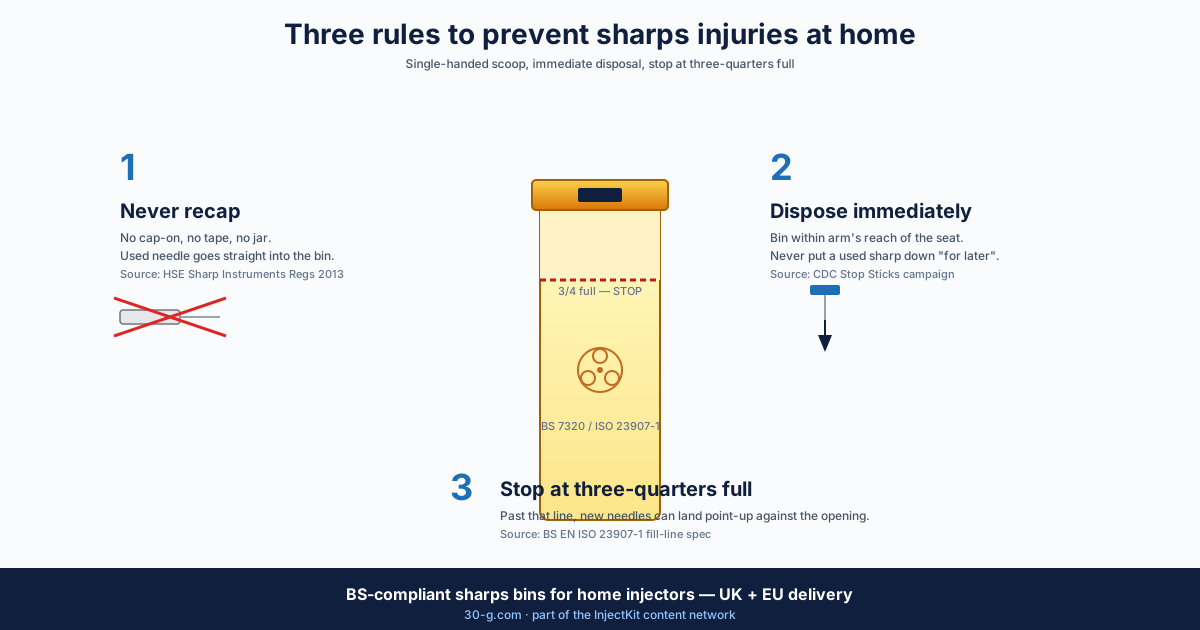
Sharps injuries at home almost always happen at one of three moments: recapping a used needle, fishing a sharps bin out of an overflowing bag, or cleaning up after a child or pet has reached the injection area. Prevention is three rules: never recap, dispose immediately into a rigid sharps bin no more than three-quarters full, and keep used sharps out of regular waste, bedding, and reach. Everything else is variations on those three.
Why this matters
A home injector who uses one needle a week for a year handles 52 used sharps. Across the UK and EU, household needlestick injuries — accidents at home rather than in a healthcare setting — account for a meaningful share of community-acquired bloodborne-pathogen exposure scares, almost all of which are preventable. The HSE's Sharp Instruments in Healthcare Regulations 2013 govern professional settings, but the principles apply equally to home use: control the sharp from the moment the cap comes off to the moment it's locked in a disposal container.
This guide is the home-user companion to sharps disposal at home — that one covers where used sharps go and the UK/EU regulations; this one covers how to handle them so you never have to think about the disposal step under pressure.
The three core rules
Rule 1: Never recap a used needle
The single biggest cause of avoidable needlestick injury is recapping — putting the plastic cap back onto a used needle. The mechanics are predictable: one hand holds the cap, the other guides the needle in, the needle misses the cap centre, the needle pierces the hand holding the cap.
The professional standard is the single-handed scoop technique when recapping is unavoidable: lay the cap on a flat surface, slide the needle into it without using the other hand at all, then lift the syringe straight up. But for home use the rule simplifies further: don't recap at all. The used needle goes directly into the sharps bin. The original cap goes in the regular waste.
The one exception: pen needles that ship with a small outer cap and need that cap re-applied for safe pen-needle removal. Even then, the outer cap is the one designed for it; the inner cap (the one you removed to inject) is never reattached.
Rule 2: Dispose immediately
Drop the used needle into the sharps bin within seconds of withdrawing it from the skin. Don't put it down on the bedside table to "deal with later." Don't leave it on top of the sharps bin to drop in next time. Don't carry it across the room.
The window of risk is the period between withdrawal and disposal. Most home needlestick injuries happen in that window — to the injector themselves, to a partner who reaches over the bedside table, to a child who picks up the visible needle out of curiosity.
Position the sharps bin within arm's reach of where you inject. If your injection station is the bathroom counter, the bin lives on the counter. If you inject at the kitchen table, the bin lives on the kitchen table. Moving the bin between sessions is a habit worth building only if the alternative is a bin that ends up forgotten.
Rule 3: Use a proper sharps bin and stop filling at three-quarters
A real sharps bin is a rigid, puncture-resistant container with a one-way deposit slot — you can drop sharps in but you can't reach in to retrieve them. UK NHS bins are colour-coded (yellow lid for general sharps); EU equivalents follow BS EN ISO 23907-1.
What is not a sharps bin:
- An old laundry detergent bottle. The plastic isn't puncture-resistant; the cap unscrews; you'll cut yourself reaching past the rim.
- A glass jar. Glass breaks when dropped, and broken glass + used needles is an emergency.
- A tin can with the lid removed. The cut edge of the can is itself a sharp; the bin contents shift; the lid doesn't seal.
- A cardboard box. Even thick cardboard punctures.
Stop filling the bin at the visible three-quarters-full line (every BS-compliant bin has one). Past that point, dropping in a new needle no longer reliably lands point-down; the contents stack and the new needle can sit point-up against the opening. This is the failure mode that catches careless hands.
Equipment that prevents injury
| Item | Why |
|---|---|
| BS 7320 / ISO 23907-1 sharps bin (0.5L–2L) | Rigid + one-way + secure closure; comply with UK/EU regulations |
| Pen needle remover (for pen users) | Mechanical detachment of the needle from the pen without your hand near the tip |
| Single-use safety-engineered syringes (where available) | Some syringe brands include a sliding sheath that auto-covers the needle after injection |
| Magnetic sharps bin holder | Mounts the bin to the side of the bedside table within arm's reach |
| Sharps bin closing lid (final-closure type) | Permanently seals the bin when full — no chance of contents falling out during disposal |
The safety-engineered syringes (sometimes called "safety sharps" or "auto-shield syringes") have a small additional cost but eliminate the highest-risk moment. For frequent home injectors — daily insulin users in particular — they're worth the marginal price. For weekly GLP-1 users with pre-filled pens, the pen design already handles needle retraction internally.
Setting up an injection station that prevents injuries
A good injection station has six elements positioned within arm's reach of the seat or bed where you inject:
- Clean, flat surface large enough for your supplies.
- Sharps bin, three-quarters-empty, lid closed between injections, opened just before disposal.
- Light source bright enough that you can see what you're doing (overhead light, lamp, or natural daylight).
- Alcohol swabs and dry gauze in their original sealed packaging.
- Syringe and medication, retrieved from storage just before use.
- A small dish or tray for the brief seconds between drawing and injecting — never the bare counter where the needle could roll.
Optional but high-leverage:
- A no-pets-or-kids rule for the room while you're injecting and for 60 seconds after. Cats in particular are drawn to small moving objects (the syringe, the swab wrapper) and to surfaces at hand height.
- A spare empty sharps bin behind the active one. When the active one hits three-quarters full, you switch — no scramble for a replacement.
For the bedside set-up, mount the sharps bin to the side of the bedside table at chest height when you're sitting on the bed. The mounted position prevents the bin from tipping if knocked, and the height means you don't have to look down (or worse, fumble) to find the slot.
When the needle is in the body of another person or animal
Most home injectors administer to themselves. Some inject pets (insulin for diabetic cats and dogs) or assist a partner. The risk pattern shifts:
Injecting a pet is the highest-injury scenario per the AVMA's literature: the animal moves, the needle deflects, the handler's other hand is often holding the pet still and is in the line of fire. The mitigations:
- Two-person restraint where possible — one person calms and restrains the pet, the other injects.
- Pre-load the syringe out of sight of the animal.
- A 31G or 30G needle (used for vet subq) is fine enough that a sudden flinch usually doesn't tear tissue — but it can still puncture the handler's hand.
- For cats, the scruff-of-the-neck subq site at a 45° angle is the safest because the loose skin holds the needle pointing away from your other hand. See cat restraint techniques and diabetes in cats for the technique side.
Injecting a partner with their consent (e.g. testosterone IM administered by a spouse) shifts the risk to the inject-er. Use the same single-handed scoop / no-recap rule; have the partner remain still for 5-10 seconds after withdrawal so you can dispose of the needle without rushing.
What to do if a needlestick injury happens
A needlestick injury at home should be treated as a possible bloodborne-pathogen exposure even when you know the source (yourself, your pet, your partner). The risk varies dramatically with what was on the needle and how deep the stick was, but the immediate response is the same.
Step 1: Encourage bleeding. Don't squeeze hard — let the wound bleed freely under cool running water for at least 30 seconds. The flushing action reduces contamination.
Step 2: Wash thoroughly with soap and water. No bleach, no harsh disinfectants on the skin — they damage tissue without adding antimicrobial benefit for fresh sticks.
Step 3: Cover the wound with a clean, dry plaster.
Step 4: Document the incident. When it happened, what was on the needle (your own medication, B12, insulin, etc.), how deep the stick was, whether the needle was new or used.
Step 5: Contact NHS 111 (UK) or your local equivalent. The triage will assess whether post-exposure prophylaxis (PEP) is needed. For a self-stick with your own clean injection medication and no infectious source, PEP is rarely needed — but the call still gets the incident logged. If the source is a different person (e.g. you stuck yourself with a needle previously used on a partner), this becomes a higher-priority assessment.
Step 6: Tetanus. Check your tetanus vaccination is current (within 10 years). If unsure, NHS 111 will advise.
Step 7: Hepatitis B vaccination. Adults who don't routinely handle medical sharps may not have hepatitis B vaccination on their record. After a needlestick — especially a contaminated one — vaccination is sometimes recommended even if you weren't due. Discuss with the GP.
Don't ignore the stick because "it was only my own needle." The disposal-step injuries (reaching into an overflowing bin, fishing a dropped needle off the floor, finding a needle in the bedding two days later) often involve needles whose history you've forgotten. Treat every stick as an incident worth documenting.
What can go wrong (in prevention)
The bin tips over and contents spill.
Most likely cause is a bin that wasn't secured or that's been moved while heavy. Don't pick up loose needles with bare hands. Use long tongs or wear thick (sharps-resistant) gloves; sweep the area with a stiff card; transfer everything into a fresh sharps bin. Don't put loose sharps into a regular bin bag while you find the bin — the bag is the source of the worst injuries.
A child or pet has been in the room with a used needle visible.
Inspect the area carefully — under furniture, in bedding, on the floor along the wall. Don't assume the needle is still where you last saw it; pets move them. If you can't find it, treat the area as contaminated until you do.
You drop a used needle and lose sight of it briefly.
Stop, do not move your feet, and look carefully. Use a torch on the floor if needed. The needle is almost always within 50 cm of where you were standing. Once found, into the sharps bin immediately. If not found, mark the area and exclude pets/children until you do.
You realise the sharps bin is full and you've just injected.
Drop the used needle into any rigid, puncture-resistant secondary container (a small plastic food-storage box with a tight lid works in a pinch). Transfer to a new sharps bin within 24 hours. Don't leave a used needle loose on a counter.
You find an unfamiliar used needle in the home (e.g. when cleaning, after a guest, in unexpected places).
Treat as contaminated. Use tongs or a folded card to pick it up; drop directly into a sharps bin. If you live in a shared household with someone who self-injects, agree a single designated injection area + bin location to prevent stray sharps.
FAQ
Are sharps bins free in the UK?
Yes, for most NHS-prescribed injection regimens — request via the GP. Private prescription holders (private GLP-1, private testosterone) usually buy them directly or get a return-by-post sharps service from the prescribing clinic. Cost is £5–15 for a 1L bin from pharmacy or online.
Can I put used sharps in my regular household bin if I tape the cap on?
No. The cap-on-with-tape approach was common before purpose-designed sharps bins were widely available; it's not acceptable now and is illegal in most UK and EU jurisdictions because the household waste handler has no way to know what's in the package. Use a sharps bin.
How long can I keep a used sharps bin at home?
UK regulations don't set a strict expiry once sealed, but most NHS guidance recommends disposal within three months of first use. Council collection cycles for healthcare waste vary; check your council's website. Don't store a full bin in a hot environment (loft, conservatory) — heat causes some plastic bins to deform.
What if a child finds a used needle and pricks themselves?
Same response as for an adult: encourage bleeding under running water, wash with soap, cover, then contact NHS 111. Children get higher-priority telephone triage. Tetanus and hep B status will be checked.
Are pen needles less dangerous than syringes?
Slightly. Most pen needles are shorter (4-6 mm) and have a smaller exposed-needle window than a 25 mm IM syringe. But the disposal rule is identical: used pen needles go straight into the sharps bin. Don't try to reuse pen needles "because they're so small."
Do I need to wear gloves to inject at home?
No, gloves are not required for self-injection in clean home conditions and the NHS doesn't recommend them. Hand washing before and after the injection achieves the practical hygiene goal. Gloves matter for healthcare workers handling other people's blood, not for someone injecting themselves.
Related reading
- Sharps Disposal at Home: UK & EU Guide — where used sharps go after the bin is full
- Reusing Insulin Needles: Why It's Risky — companion sterility reasoning
- Intramuscular Injection Technique: Beginner's Guide — IM technique with sharps-safe handling baked in
- How to Inject Properly — full step-by-step injection technique
For the supplies: InjectKit's 1L sharps containers ship across the UK and EU and meet BS EN ISO 23907-1.
Citations
- HSE, "Health and Safety (Sharp Instruments in Healthcare) Regulations 2013" — hse.gov.uk
- CDC, "Stop Sticks Campaign — preventing needlestick injuries" — cdc.gov
- OSHA, "Bloodborne Pathogens Standard, 29 CFR 1910.1030" — osha.gov
- WHO, "Best practices for injection safety and related procedures" — who.int
- NHS, "Sharps injuries: what to do" — nhs.uk
- BS EN ISO 23907-1:2019 — Sharps injury protection — Requirements and test methods for sharps containers
Frequently asked questions
Are sharps bins free in the UK? +
Yes, for most NHS-prescribed injection regimens — request via the GP. Private prescription holders (private GLP-1, private testosterone) usually buy them directly or get a return-by-post sharps service from the prescribing clinic. Cost is £5–15 for a 1L bin from pharmacy or online.
Can I put used sharps in my regular household bin if I tape the cap on? +
No. The cap-on-with-tape approach was common before purpose-designed sharps bins were widely available; it's not acceptable now and is illegal in most UK and EU jurisdictions because the household waste handler has no way to know what's in the package. Use a sharps bin.
How long can I keep a used sharps bin at home? +
UK regulations don't set a strict expiry once sealed, but most NHS guidance recommends disposal within three months of first use. Council collection cycles for healthcare waste vary; check your council's website. Don't store a full bin in a hot environment (loft, conservatory) — heat causes some plastic bins to deform.
What if a child finds a used needle and pricks themselves? +
Same response as for an adult: encourage bleeding under running water, wash with soap, cover, then contact NHS 111. Children get higher-priority telephone triage. Tetanus and hep B status will be checked.
Are pen needles less dangerous than syringes? +
Slightly. Most pen needles are shorter (4-6 mm) and have a smaller exposed-needle window than a 25 mm IM syringe. But the disposal rule is identical: used pen needles go straight into the sharps bin. Don't try to reuse pen needles "because they're so small."
Do I need to wear gloves to inject at home? +
No, gloves are not required for self-injection in clean home conditions and the NHS doesn't recommend them. Hand washing before and after the injection achieves the practical hygiene goal. Gloves matter for healthcare workers handling other people's blood, not for someone injecting themselves.
Related reading
Sharps Disposal at Home: A UK and EU Guide for Self-Injectors
Sharps bin and needle disposal guide for the UK and EU — NHS yellow-bin rules, BS EN ISO 23907-1 standard, pharmacy take-back schemes and how to choose the right size.
29G, 30G, 31G: How to Actually Pick a Needle Gauge
29G vs 30G vs 31G — how needle gauge actually works, why the number is backwards, and why 30G is the default for self-injection. UK practical guide.
Get your supplies
CE-marked syringes and alcohol prep pads. Shipped from Spain across the EU and UK.