Sharps Disposal at Home: A UK and EU Guide for Self-Injectors
Sharps bin and needle disposal guide for the UK and EU — NHS yellow-bin rules, BS EN ISO 23907-1 standard, pharmacy take-back schemes and how to choose the right size.
By Daisy Lin
Medical Writer • Reviewed April 27, 2026
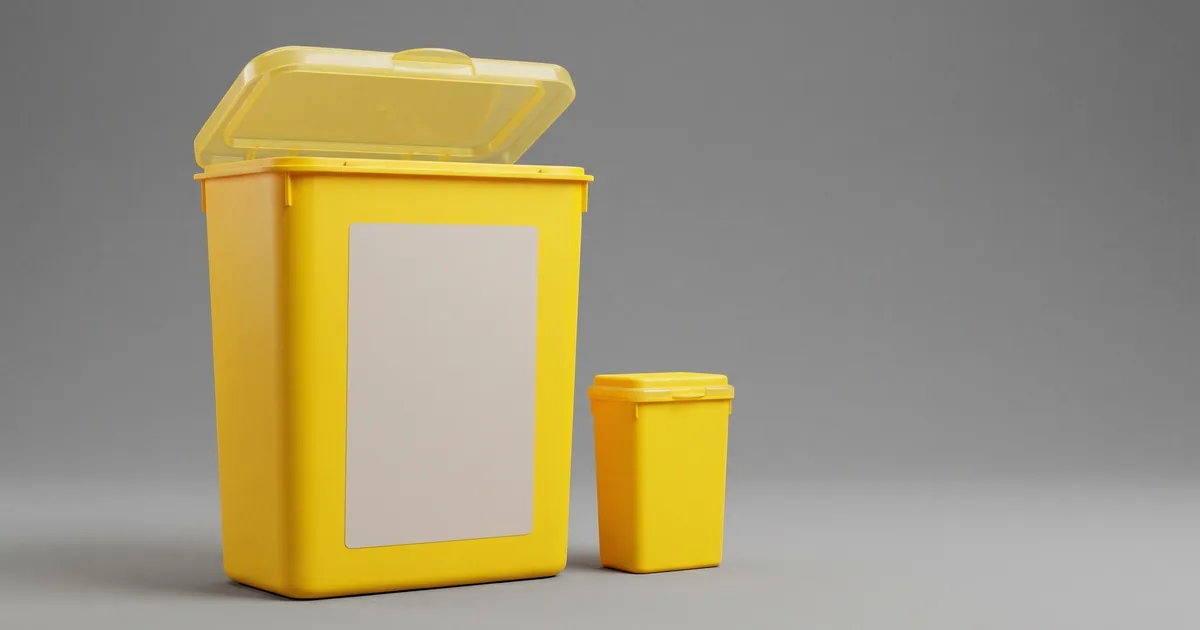
Used needles, syringes, lancets and pen needles are clinical waste — they cannot legally go in household refuse anywhere in the UK or EU. In the UK, NHS prescription users typically get a free yellow sharps bin and council collection (private prescription users may pay a fee or use pharmacy return). Across the EU, pharmacies are the default drop-off: France's DASTRI scheme provides free containers nationally, Germany accepts sealed sharps at most Apotheken, Spain and Italy use pharmacy or local-authority routes. The container itself must meet BS EN ISO 23907-1 (the current standard) and UN 3291 for transport.
This guide covers the legal position in the UK and major EU markets, what a sharps bin actually has to do to be compliant, and how to choose the right size for the way you inject.
Why home sharps disposal matters
Loose needles in household waste cause real injuries. Refuse collectors and recycling workers in the UK report needlestick injuries every year traceable to bin bags, and the consequences range from a tetanus booster to a six-month course of antiretroviral prophylaxis depending on what the needle was used for and what is known about the source. A used syringe in a black bag is, in legal terms, a Category B infectious waste item — governed by the Hazardous Waste Regulations in England, the Special Waste Regulations in Scotland, and equivalent provisions across the EU.
This is why every country in the EEA has a take-back or compliant-container regime for home sharps. The specifics vary, but the underlying principle is the same: if you generated the sharp at home, you are responsible for ensuring it ends up in a container that is puncture-proof, leak-proof, sealable, and clearly identifiable as clinical waste.
UK rules: NHS yellow-bin programme and private disposal
In England, Wales and Northern Ireland, sharps disposal for home injectors is administered through local councils, which are generally obliged to collect clinical waste from domestic premises on request. The most common arrangement for NHS prescription users is a referral-based yellow sharps bin scheme: a GP, district nurse or specialist nurse refers the patient, the bin is supplied (often on FP10 prescription or via the council), and the council collects and exchanges it. In most local authority areas this collection is free for NHS-prescribed users, but eligibility, supply route and any charges are set locally and do vary between councils, so confirm the current arrangement with your own council or surgery.
For private prescription users — including most patients on private GLP-1 prescriptions, private HRT, or any compounded medication — the council route may still be available but typically attracts a collection fee, which varies from a nominal charge to several pounds per collection. Many private clinics now bundle a return-by-post sharps disposal service into the prescription cost, which is the simplest option for occasional users. Some pharmacies, particularly larger Boots and Lloyds branches, also offer paid sharps return.
In Scotland the equivalent service is operated by NHS boards rather than councils, but the principle is broadly the same: typically free for prescribed users, with charges more common for self-funded routes. The NHS sharps disposal patient information page is the working starting point, with council-by-council details linked through.
The container itself should meet BS EN ISO 23907-1 and UN 3291. BS EN ISO 23907-1 is the current single-use sharps container standard (it superseded the older BS 7320:1990) and governs design — the bin must have a puncture-resistant body, a one-way fill aperture, a temporary closure for in-use periods and a permanent closure for final disposal, and clear yellow colouring with the international biohazard symbol. UN 3291 is the United Nations packaging classification that confirms the container is fit to transport infectious clinical waste through the disposal supply chain. Any compliant home sharps bin sold in the UK will be marked with the relevant standards on the label; if it is not, do not use it for sharps.
EU country variations
Across the major EU markets the model is broadly similar, with pharmacy take-back as the dominant route. In Germany, used sharps are collected in a Sammelbehälter that conforms to ADR / UN 3291, and most pharmacies (Apotheken) accept full containers as part of standard service — some larger DocMorris and Shop Apotheke branches even sell empty bins alongside the stocking medication. Disposal is generally free at the point of return.
In Spain, the Punto SIGRE network at pharmacies handles unused medicines and their packaging, but does not accept loose used needles or sharps. Sharps from home self-injection are returned in a sealed, compliant container through the local hazardous-waste route — typically the pharmacy or a local health-authority collection point, with arrangements set at the autonomous-community level. In practice, asking at your local pharmacy is the right starting point, and the underlying national framework is the Spanish waste law (Ley 7/2022 on waste and contaminated soils for a circular economy).
In France, the DASTRI scheme provides free sharps collection containers through pharmacies for patients on self-administered injectable treatments, funded by a levy on pharmaceutical manufacturers. The scheme is national and the eligibility is automatic for anyone with a prescription for an injectable.
In Italy, sharps fall under the Rifiuti Sanitari Pericolosi a Rischio Infettivo classification and are typically returned through pharmacies or local health authority (ASL) collection points, with significant regional variation.
The common thread across all four is that the pharmacy is your default disposal point. If you live in any EU country and are not sure where to take a full bin, walking into your nearest pharmacy with a sealed container is almost always the right answer.
What goes in a sharps bin and what does not
A sharps bin is for items with a sharp end that have been in contact with body fluids or medication. That includes used needles, lancets, pen needles, integrated insulin syringes, vial draw needles, blunt fill needles after use, and broken glass ampoules. Empty pen cartridges, vial stoppers and drug residue can go in the bin alongside the sharp itself if convenient.
What does not go in a sharps bin: household scissors, kitchen knives, razors, sewing pins, garden shears, or any non-clinical sharp. These are general or commercial waste depending on context, but mixing them with clinical sharps contaminates the disposal stream and adds cost. Empty cardboard packaging from injection kits is ordinary recycling. Plastic syringe barrels with the needle removed and capped are ambiguous — most disposal services prefer them to go in the sharps bin to avoid any confusion, even though strictly the plastic alone is not a sharp.
Liquid medication — including unused contents of a partially full vial — should not be poured into a sharps bin. Returning unused medication to a pharmacy for incineration is the correct route.
Filling, sealing and disposing — the actual procedure
Use the temporary closure (a sliding lid or hinged flap, depending on the model) when the bin is in use. Drop each used sharp in immediately after the injection — do not let used needles accumulate on a surface, do not recap them, and do not transport loose sharps to the bin from another room. The fill-line marker on most compliant bins is set at three-quarters full and is the genuine cut-off; pushing past it makes the lock unreliable.
When the bin reaches the fill line, close the temporary aperture, then engage the permanent closure mechanism. On most compliant bins this is a final lock that cannot be reopened. Once permanently sealed, the bin is ready for disposal.
For NHS prescription users in the UK, ring the council's clinical waste line to schedule a collection, or use the online portal if your local authority offers one. For private users, follow whichever scheme you are signed up to: pharmacy return, post-back to a private clinical waste contractor, or paid council collection. In the EU, take the sealed bin to a pharmacy.
A full bin should never be stored for extended periods at home. Once sealed, dispose of it within a few weeks at most.
Choosing the right size
Sharps bin capacity sounds abstract until you map it to actual use. A 0.5 L bin holds approximately 50 to 100 used insulin syringes or pen needles, depending on geometry, and is the right choice for a once- or twice-weekly injector — typically a few months of capacity for a GLP-1 user on weekly dosing, or about a month for someone injecting daily.
A 1 L bin holds roughly 150 to 250 used sharps, and is the right choice for daily injectors (insulin, fertility cycles), households with more than one person injecting, or anyone who would rather change a bin every few months than every few weeks. The 1 L sharps container is the most popular size we ship, and is the one we include as standard in the larger kits.
For travel, a mini sharps container (around 0.2 L) is small enough to fit in a wash bag without taking over.
Whichever size you choose, the underlying calculation is the same: a sealed bin should leave the house full but not overfull, on a cadence that means you are not living with weeks of accumulated clinical waste.
FAQ
Are NHS yellow sharps bins free in the UK? For NHS prescription users they are usually free — your local council provides and collects them, often after a referral from your GP or specialist nurse. For private prescription users, fees can apply and arrangements vary by council, so confirm with your own local authority.
What is the current sharps-container standard? The current single-use sharps container standard is BS EN ISO 23907-1, which superseded the older BS 7320:1990. It defines design requirements such as a puncture-resistant body, one-way fill aperture, temporary and permanent closures, and yellow colouring with biohazard marking. Compliant bins sold in the UK will state the relevant standards (and UN 3291 for transport) on the label.
Can I put loose needles in a household bin? No. It is unlawful and dangerous. Loose sharps in domestic refuse cause needlestick injuries to refuse workers and breach the Hazardous Waste Regulations. All used needles must go in a compliant sharps container.
What size sharps bin do I need? A 0.5 L bin suits a once- or twice-weekly injector. A 1 L bin suits daily injectors or multi-person households. For travel, a small 0.2 L mini bin is enough for short trips.
Where do I dispose of sharps in Germany, Spain, France or Italy? Pharmacies are the default disposal point in all four countries. Take the sealed bin to your nearest pharmacy; in France the national DASTRI scheme also provides free containers to prescribed users.
Can I put a recapped needle in regular bin waste? No. Recapping is itself a leading cause of needlestick injury, and the recapped sharp is still a clinical sharp legally. Drop it in the sharps bin uncapped, immediately after use.
If you need to restock, the 1 L sharps container is the size that fits most home injection routines for several months of use, and ships with the rest of our 30G insulin syringe range.
Sources
- UK Environment Agency, Hazardous Waste Regulations 2005 (England and Wales) — gov.uk
- BS EN ISO 23907-1:2019 Sharps injury protection — Requirements and test methods (single-use sharps containers) — iso.org
- UN Recommendations on the Transport of Dangerous Goods, Class 6.2 Infectious Substances (UN 3291) — unece.org
- NHS, Sharps disposal in the community — nhs.uk
- DASTRI, Éco-organisme français de la collecte des DASRI — dastri.fr
- Bundesinstitut für Arzneimittel und Medizinprodukte (BfArM), Entsorgung von Arzneimitteln und Sharps — bfarm.de
- World Health Organization, Safe management of wastes from health-care activities — who.int
This article is for general information only and is not medical advice. Always consult your prescriber or pharmacist for guidance specific to your situation.
Frequently asked questions
Are NHS yellow sharps bins free in the UK? +
For NHS prescription users they are usually free — your local council provides and collects them, often after a referral from your GP or specialist nurse. For private prescription users, fees can apply and arrangements vary by council, so confirm with your own local authority.
What is the current sharps-container standard? +
The current single-use sharps container standard is BS EN ISO 23907-1, which superseded the older BS 7320:1990. It defines design requirements such as a puncture-resistant body, one-way fill aperture, temporary and permanent closures, and yellow colouring with biohazard marking. Compliant bins sold in the UK will state the relevant standards (and UN 3291 for transport) on the label.
Can I put loose needles in a household bin? +
No. It is unlawful and dangerous. Loose sharps in domestic refuse cause needlestick injuries to refuse workers and breach the Hazardous Waste Regulations. All used needles must go in a compliant sharps container.
What size sharps bin do I need? +
A 0.5 L bin suits a once- or twice-weekly injector. A 1 L bin suits daily injectors or multi-person households. For travel, a small 0.2 L mini bin is enough for short trips.
Where do I dispose of sharps in Germany, Spain, France or Italy? +
Pharmacies are the default disposal point in all four countries. Take the sealed bin to your nearest pharmacy; in France the national DASTRI scheme also provides free containers to prescribed users.
Can I put a recapped needle in regular bin waste? +
No. Recapping is itself a leading cause of needlestick injury, and the recapped sharp is still a clinical sharp legally. Drop it in the sharps bin uncapped, immediately after use.
If you need to restock, the 1 L sharps container is the size that fits most home injection routines for several months of use, and ships with the rest of our 30G insulin syringe range.
Related reading
Get your supplies
CE-marked syringes and alcohol prep pads. Shipped from Spain across the EU and UK.