U-100 vs U-40 Insulin Syringes: Why Pets Need a Different Scale
U-40 vs U-100 insulin syringes explained — why veterinary insulin uses a different scale, why mixing them up is dangerous, and how to pick the right one.
Founder & Compliance Lead • Reviewed April 27, 2026
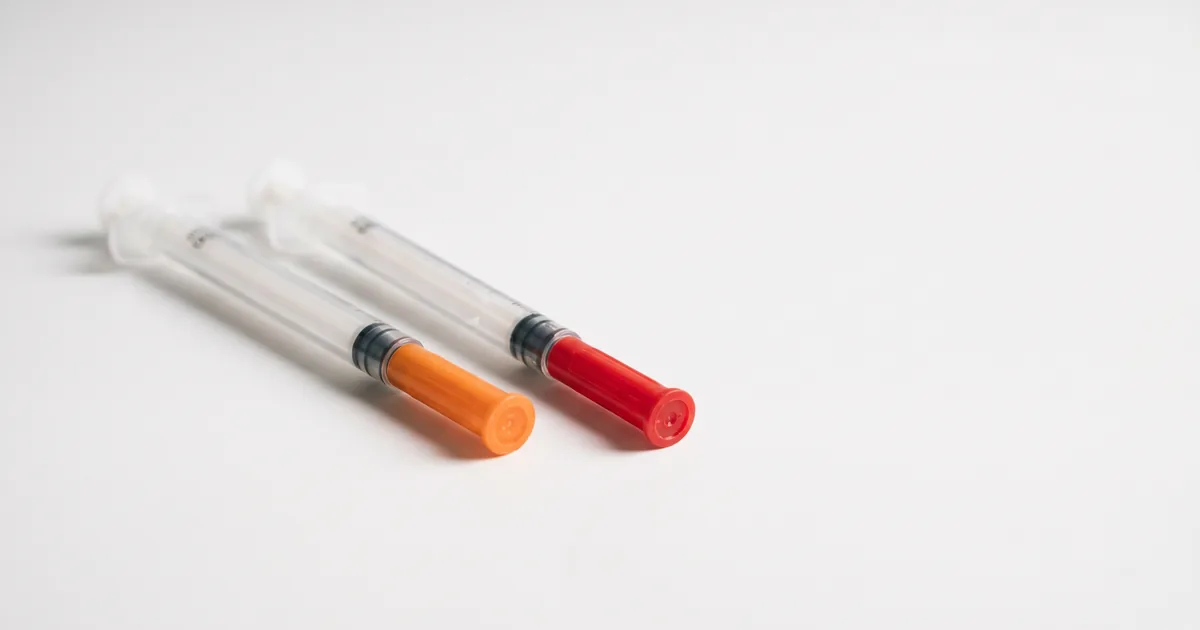
U-40 and U-100 are insulin concentrations — 40 or 100 units of active ingredient per millilitre — and the two scales are not interchangeable. Veterinary insulins like Caninsulin (Vetsulin) and Prozinc are U-40; human insulins are U-100. If you draw "three units" on a U-100 syringe from a U-40 vial, your cat gets 40% of the prescribed dose. If you try to "convert" by drawing 2.5 times the volume on a U-100 syringe, you risk a severe hypoglycaemic episode. The syringe scale must match the insulin concentration — full stop.
This guide explains where the two standards come from and why mixing them up is the most common avoidable error in home insulin therapy for pets. It is written for owners of a freshly diagnosed diabetic dog or cat.
What the number means
"U" stands for units per millilitre. A U-100 insulin solution contains 100 units of active ingredient per millilitre. A U-40 solution contains 40 units per millilitre. That is the entire chemistry.
It is not a chemical difference in the insulin itself — the molecule is the same, often from the same manufacturer. It is a concentration difference, comparable to an espresso doppio versus a lungo: same coffee, different ratio of water to active.
An insulin syringe is calibrated to one specific concentration. The scale — the marks on the barrel — does not say "0.1 mL" but "4 units." Whether one mark really equals 4 units of active ingredient depends on whether the concentration in the vial matches the syringe's scale.
Why two standards exist at all
The short history: U-40 was the global standard for decades. Human medicine moved to U-100 in the 1980s because the same dose then fits in a smaller volume — more comfortable for patients injecting several times a day, and essential for insulin pens, which are built around concentrated solutions.
Veterinary medicine stayed with U-40. The reasons are part historical, part practical. Animal insulins are often suspensions that would be unstable at higher concentrations. Per-animal doses are small, so the larger volume of U-40 actually gives a precision advantage. And the established brands (Caninsulin/Vetsulin from MSD, Prozinc from Boehringer Ingelheim) have been U-40 for decades — a switch would invalidate thousands of dosing protocols overnight.
The result: U-100 sits in the human pharmacy fridge, U-40 sits in the vet's fridge. The two boxes look almost identical.
What happens if you mix them up
Three scenarios, all with the same prescription: three units of Caninsulin (U-40), twice daily.
- Scenario A — everything right
- U-40 syringe, U-40 insulin. Three marks on the scale = three units of active = 0.075 mL of solution. This works.
- Scenario B — U-100 syringe, U-40 insulin
- the owner draws "three units" on a U-100 syringe. But the U-100 syringe is calibrated so that three units equals 0.03 mL — which would be three units of U-100 active. Drawn from a U-40 vial, 0.03 mL is only 1.2 units. The cat gets 40% of the prescribed dose. The treatment does not work, blood glucose stays high, the owner thinks the insulin is "weak" and starts increasing on their own — and eventually trips up the other way.
- Scenario C — U-40 insulin, U-100 syringe, "converted"
- the owner knows the concentrations differ and tries to compensate. Out of the head: "U-40 is less concentrated, so I need more volume." Instead of three marks on U-100, they draw 2.5 times that — about 7 to 8 marks. The cat gets 2.5 times the dose — for a small cat on three units standard, that is 7.5 units. Enough for severe hypoglycaemia and a seizure.
Scenario C is statistically the most dangerous because it catches owners who are trying hardest and think they are being clever.
The conversion table (for illustration, not for use)
| U-40 dose (units) | Volume in mL | On a U-100 scale (units) |
|---|---|---|
| 1 | 0.025 mL | 2.5 |
| 2 | 0.050 mL | 5.0 |
| 3 | 0.075 mL | 7.5 |
| 4 | 0.100 mL | 10.0 |
| 5 | 0.125 mL | 12.5 |
| 6 | 0.150 mL | 15.0 |
| 8 | 0.200 mL | 20.0 |
| 10 | 0.250 mL | 25.0 |
The table is here so the 2.5× factor becomes visible — not so you use it. Every misread mark, every misplaced decimal, gets multiplied by 2.5. That is the leverage that produces hypoglycaemic events.
UK and EU vet bodies — including the Veterinary Medicines Directorate and the European veterinary diabetes societies — give the same advice: never convert. Always use the syringe that matches the insulin concentration.
How to spot the right syringe
Three things to check on every pack before you open the box:
- "U-40" on the syringe packaging itself — usually printed prominently, often in red or with a paw symbol.
- Scale and maximum value — a 1 mL U-40 syringe is calibrated to 40 units, not 100.
- Vet-coloured needle cap — many manufacturers (BD Vet, Sol-Vet) use different colour codes from the human line, specifically to prevent stockroom mix-ups.
If in doubt, place the pack next to the insulin vial. If both say U-40, you are fine.
Our U-40 line
We carry three U-40 vet insulin syringes covering the three volumes used in practice:
- 0.3 mL with 30G × 8 mm needle — the micro-dose option for cats and small dogs on daily totals under 12 units.
- 0.5 mL with 29G × 12.7 mm needle — the all-rounder for most cats and small dogs.
- 1 mL with 29G × 12.7 mm needle — for medium and large dogs on higher doses.
All three are ISO 13485 manufactured, supplied in sterile sleeves of 10, ethylene-oxide sterilised, and shipped from our EU warehouse in 2 to 3 working days. Free shipping above 39 € — a 100-pack always sits above the threshold.
FAQ
What does U-40 vs U-100 mean on insulin? The number is the concentration: 40 or 100 units of active per millilitre. A U-100 syringe and a U-40 vial are not compatible — the scales differ by 2.5×.
What insulin syringe does my cat need? Veterinary insulins (Caninsulin, Prozinc) are U-40. Use a U-40 syringe — typically 0.3 mL for low doses or 0.5 mL as an all-rounder.
Can I convert a U-100 syringe if I don't have a U-40 to hand? No. The maths looks simple (factor 2.5), but the real-world error rate is high and the consequence of getting it wrong can be severe hypoglycaemia. Skip a dose and pick up the right syringe — after speaking to your vet.
Why hasn't veterinary medicine switched to U-100? Animal insulins are often suspensions less stable at higher concentrations, and per-animal doses are small enough that U-40's larger volume gives a measurement-precision advantage.
Where do I buy U-40 insulin syringes in the UK or EU? Through your vet practice, some online suppliers, and our EU-shipped range. Look for "U-40" and "Vet" on the packaging — human syringes are almost always U-100.
The scale question is one of the few places in home pet medicine where there is no "almost right." Either the syringe matches the insulin or it does not. Two minutes checking the box at order time spares you a whole class of risk for the rest of treatment.
If you are about to order, the 0.5 mL U-40 vet syringe 100-pack is the most common starting choice for a freshly diagnosed cat or small dog, with the 0.3 mL micro-dose variant for small daily totals.
Sources
- UK Veterinary Medicines Directorate, Authorised veterinary medicines product information — gov.uk
- MSD Animal Health, Caninsulin product information — msd-animal-health.com
- Boehringer Ingelheim, ProZinc product information — boehringer-ingelheim.com
- American Animal Hospital Association, AAHA Diabetes Management Guidelines for Dogs and Cats — aaha.org
- International Society of Feline Medicine, ISFM Consensus Guidelines on Diabetes Mellitus in Cats — icatcare.org
- World Small Animal Veterinary Association, Diabetes Mellitus guidelines — wsava.org
- ISO 8537:2016, Sterile single-use syringes, with or without needle, for insulin — iso.org
This article is general information and is not a substitute for veterinary advice. Always consult your vet before changing an insulin dose.
Frequently asked questions
What does U-40 vs U-100 mean on insulin? +
The number is the concentration: 40 or 100 units of active per millilitre. A U-100 syringe and a U-40 vial are not compatible — the scales differ by 2.5×.
What insulin syringe does my cat need? +
Veterinary insulins (Caninsulin, Prozinc) are U-40. Use a U-40 syringe — typically 0.3 mL for low doses or 0.5 mL as an all-rounder.
Can I convert a U-100 syringe if I don't have a U-40 to hand? +
No. The maths looks simple (factor 2.5), but the real-world error rate is high and the consequence of getting it wrong can be severe hypoglycaemia. Skip a dose and pick up the right syringe — after speaking to your vet.
Why hasn't veterinary medicine switched to U-100? +
Animal insulins are often suspensions less stable at higher concentrations, and per-animal doses are small enough that U-40's larger volume gives a measurement-precision advantage.
Where do I buy U-40 insulin syringes in the UK or EU? +
Through your vet practice, some online suppliers, and our EU-shipped range. Look for "U-40" and "Vet" on the packaging — human syringes are almost always U-100.
The scale question is one of the few places in home pet medicine where there is no "almost right." Either the syringe matches the insulin or it does not. Two minutes checking the box at order time spares you a whole class of risk for the rest of treatment.
If you are about to order, the 0.5 mL U-40 vet syringe 100-pack is the most common starting choice for a freshly diagnosed cat or small dog, with the 0.3 mL micro-dose variant for small daily totals.
Related reading
Sol-Vet vs BD vs MSD: U-40 Vet Insulin Syringe Comparison 2026
Sol-Vet vs BD UltraFine Vet vs MSD Caninsulin syringes 2026 — pricing, UK and EU availability, shipping reliability, and the EU-warehouse alternative.
Diabetes in Cats: Which Insulin Syringe and How to Dose Correctly
Diabetes in cats — choosing the right U-40 insulin syringe, drawing the dose cleanly, sterile technique and safe disposal. A complete UK practical guide.
Insulin Storage and Travel: Fridge, Flights, Heat and the 28-Day Rule
What the EMA SmPCs actually specify for in-use insulin storage, what UK and EU airlines allow in cabin baggage, and what the 28-day rule does and doesn't mean.
Get your supplies
CE-marked syringes and alcohol prep pads. Shipped from Spain across the EU and UK.